How Long Does It Take to Heal a Herniated Disc?
Herniated disc recovery can take anywhere from several weeks to several months. Understanding what affects your recovery (and when to seek treatment) can help you get back to normal activity safely.
A herniated disc can make even simple activities difficult. Sitting at your desk, getting out of bed, driving, exercising, or picking something up from the floor can suddenly trigger back pain, numbness, tingling, or pain that travels into an arm or leg.
Naturally, one of the first questions patients ask is: How long is this going to take to heal?
There isn't one recovery timeline that applies to everyone. Some people notice significant improvement within a few weeks, while others experience symptoms for several months or longer. The location and severity of the disc injury, whether a nerve is involved, your overall health, your daily activities, and the treatment you receive can all influence how quickly you improve.
Understanding what's happening inside your spine can help set realistic expectations & help you recognize when waiting for the problem to resolve on its own may not be the best strategy.
What Happens When You Herniate a Disc?
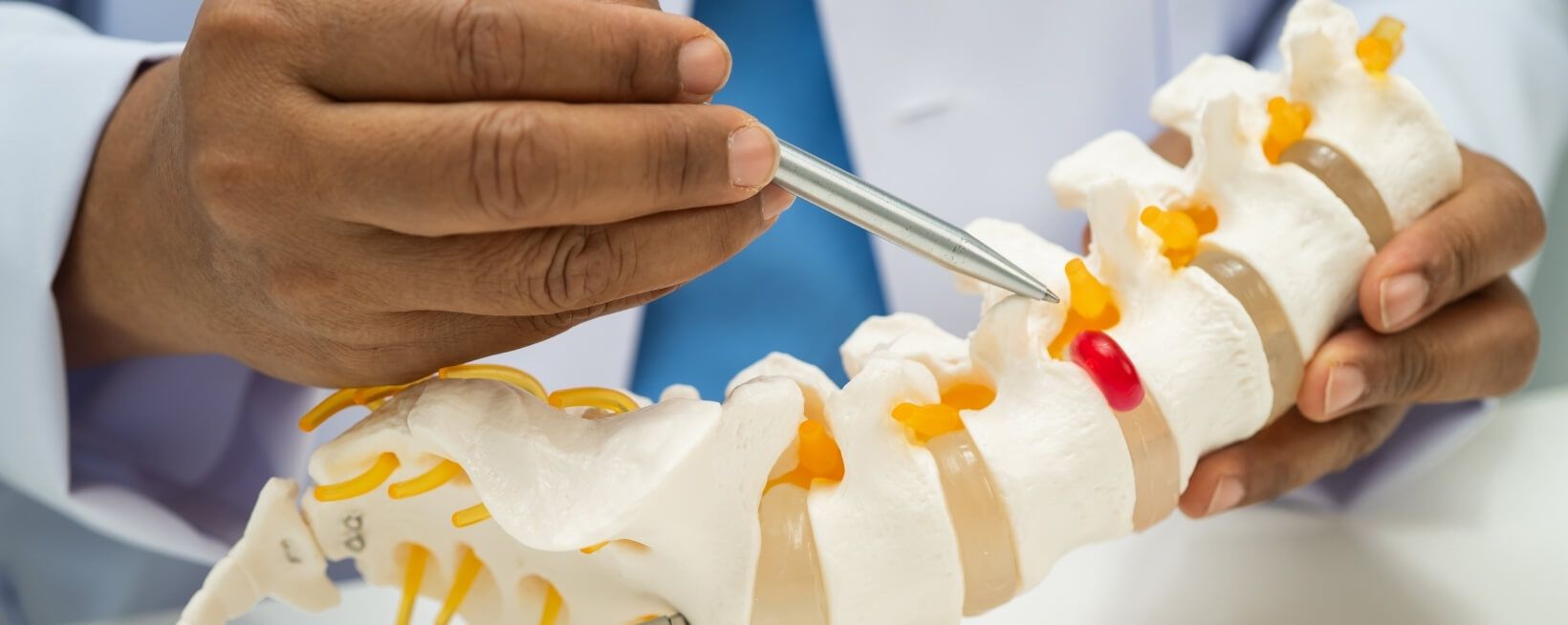
Between the vertebrae of your spine are discs that provide cushioning and help absorb forces as you bend, twist, walk, and move. Each disc has a tougher outer layer surrounding a softer, gel-like center.
A herniated disc occurs when material from inside the disc pushes through or escapes through a weakened or damaged area of the outer portion. Depending on where this happens, the displaced material can irritate or compress nearby nerve roots.
That's why a herniated disc doesn't always cause pain only in your back or neck. A lumbar disc herniation can produce sciatica, with pain, numbness, tingling, or weakness traveling through the buttock and leg. A cervical disc herniation can cause similar symptoms that travel from the neck into the shoulder, arm, or hand.
The size of the herniation doesn't always correspond directly with how much pain someone experiences. The location of the injury, inflammation, nerve involvement, and individual anatomy all play a role.
So, How Long Does a Herniated Disc Take to Heal?
Many symptomatic lumbar disc herniations improve with conservative treatment over roughly six to twelve weeks, although individual recovery times vary considerably. Some patients begin feeling better sooner, while others require several months of treatment and rehabilitation.
It's also important to distinguish between symptom improvement and complete tissue healing. You may experience a significant reduction in pain before the injured area has fully recovered. Feeling better doesn't necessarily mean the disc and surrounding structures are ready to tolerate every activity they could before the injury.
Recovery also isn't always linear. You might have several good days followed by a flare-up after prolonged sitting, lifting, travel, exercise, or another activity that places additional stress on the affected area. A temporary increase in symptoms doesn't necessarily mean you've returned to square one, but recurring flare-ups are worth discussing with your provider.
What Can Affect Herniated Disc Recovery Time?
The severity of the injury is only one factor. Your recovery can also be influenced by where the herniation is located, how much nerve irritation is present, your age and general health, previous spinal injuries, physical conditioning, occupation, and how much stress is repeatedly placed on the affected area.
Your habits during recovery matter as well. Continuing to perform movements that repeatedly aggravate the disc may prolong symptoms, while becoming completely inactive for an extended period can contribute to weakness and stiffness. Finding the appropriate balance between activity, treatment, and recovery is important.
This is one reason individualized care matters. Two people can have similar findings on imaging but very different symptoms, limitations, and recovery timelines.
Can a Herniated Disc Heal Without Surgery?
In many cases, yes. Having a herniated disc does not automatically mean you need surgery.
The body has natural mechanisms that can help reduce inflammation and, in some cases, decrease the size of herniated disc material over time. As irritation around the affected nerve decreases, pain and other symptoms may improve.
Conservative treatment is therefore commonly considered before surgery when there are no signs that require urgent surgical evaluation. Treatment may focus on reducing pain and irritation, improving spinal movement, gradually restoring strength, and reducing mechanical stress on the affected area.
However, simply waiting isn't always the same thing as actively recovering. If your symptoms aren't improving, repeatedly return, or are significantly limiting your daily life, an evaluation can help determine whether additional treatment could help.
How Treatment Can Support Your Recovery
The goal of treatment isn't to promise that a herniated disc will heal overnight. It's to create better conditions for recovery while helping you manage symptoms and regain function.
Depending on your condition, treatment may include activity modifications, therapeutic exercise and rehabilitation, chiropractic care, medical management, and other therapies selected according to the source and severity of your symptoms.
For certain disc-related conditions, non-surgical spinal decompression may also be considered. Spinal decompression uses controlled traction to gently unload areas of the spine. The goal is to reduce mechanical pressure and provide relief for appropriately selected patients with disc-related pain or nerve irritation.
At True Wellness Integrated Medicine, decompression can be incorporated into a broader treatment plan rather than treated as a one-size-fits-all solution. Your evaluation helps determine whether decompression makes sense for your particular disc injury and what other therapies may be beneficial alongside it.
When Is Your Herniated Disc Taking Too Long to Improve?
There isn't a specific day when a herniated disc suddenly becomes a chronic problem. However, if several weeks have passed without meaningful improvement, or your symptoms are getting worse instead of better, it may be time to reassess your treatment strategy.
You should also consider an evaluation if pain repeatedly returns whenever you resume normal activities, you're relying heavily on pain medication to get through the day, or numbness, tingling, or radiating pain continues to interfere with work, exercise, sleep, or everyday activities.
Certain symptoms require more urgent medical attention. New or progressive muscle weakness, significant loss of sensation, changes in bowel or bladder control, or numbness around the groin or saddle area should be evaluated promptly.
Feeling Better Is Only Part of the Goal
Getting out of pain is important, but successful recovery should also focus on restoring function and reducing the likelihood of another significant flare-up.
Once symptoms begin improving, gradually rebuilding mobility, strength, and tolerance for normal activity becomes an important part of the process. Returning to heavy lifting, intense exercise, or other demanding activities too quickly can place unnecessary stress on a spine that is still recovering.
Your provider can help determine when it's appropriate to progress your activity level and what exercises or modifications may help protect your recovery.
Don't Just Wait and Hope Your Disc Gets Better
A herniated disc can improve with time, but you don't necessarily have to spend months waiting to see what happens.
At True Wellness Integrated Medicine, we evaluate the source of your symptoms and build an individualized treatment plan designed to reduce pain, improve function, and support your body's recovery. For appropriate patients, that may include non-surgical spinal decompression along with other therapies to address the different factors contributing to your pain.
If a herniated disc is keeping you from working, sleeping, exercising, or enjoying your normal activities, schedule an evaluation with True Wellness Integrated Medicine. We'll help determine what's causing your symptoms and whether treatment, including spinal decompression, may help you move toward recovery more effectively.